A solo attorney with a real specialty and a homepage that hid it.
Avery handles complex employment-based visas, the kind other Houston firms refer out because they're too messy. Her website said "Houston Immigration Attorney." We rebuilt the entire content architecture around what she actually does, and structured every page for AI search.
The build · Homepage · Desktop
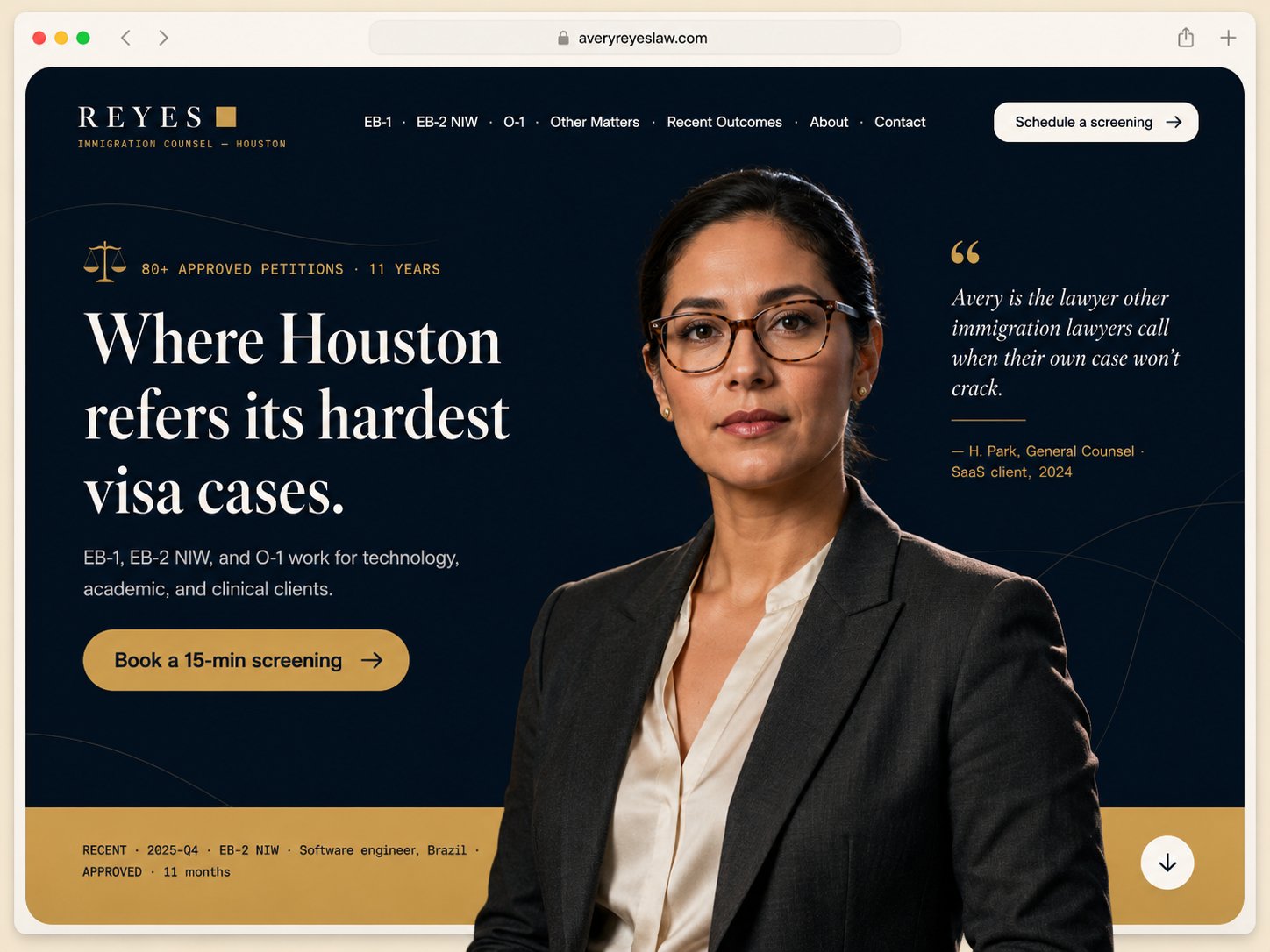
The starting point
Avery Reyes is a solo immigration attorney in Houston. She's done immigration work for 11 years. Her actual specialty: complex employment-based cases, EB-1 extraordinary ability, EB-2 NIW (national interest waivers), and O-1 extraordinary-talent visas for tech and academic clients. These are messy, high-stakes cases that most general-practice immigration firms refuse.
Her old website said "Avery Reyes, Houston Immigration Attorney" and listed eight services equally. Family-based, asylum, deportation defense, naturalization, employment-based, etc. She was being treated like a generalist by Google, by AI tools, and by prospective clients. Half her inbox was asylum cases she didn't take. Her best clients, high-skill workers needing visa expertise, were going to firms three times her size.
The diagnosis
- Generalist positioning was killing referrals. When another lawyer thinks "who do I refer this messy EB-2 to," they don't think of someone whose homepage equally promotes asylum and naturalization.
- The "high-value" search queries had almost no quality competition. "EB-1 extraordinary ability attorney Houston" had under 30 monthly searches but each one was a $15K-$30K case. Her old site ranked nowhere for it.
- Her actual experience was buried. The fact that she'd successfully handled 80+ EB-1 cases wasn't on the homepage, the about page, or the EB-1 service page. It was in a LinkedIn post from 2022.
- Zero structure for AI search. When someone asks ChatGPT "who handles EB-2 NIW cases in Houston," the AI pulls from sites with clear, structured, question-answer content. Avery's site had paragraphs of legal jargon, no FAQ structure, no schema.
The strategic shift
Stop being "a Houston immigration attorney." Become "the Houston attorney for employment-based and extraordinary-talent visas." The narrower the specialty, the higher the rate.
This is the law-firm version of the dental-practice lesson: small businesses win by being the obvious answer to a specific question, not a plausible answer to a broad one. For a solo attorney competing against 6-partner firms, depth in a niche beats breadth every time.
What we built
Repositioned the entire site around the high-value niches
The new sitemap has three "primary practice" pages prominent in the nav: EB-1 Extraordinary Ability, EB-2 National Interest Waiver, and O-1 Extraordinary Talent. The general immigration services (family-based, asylum, etc.) still exist on a secondary "Other immigration matters" page, she still takes them, they're just not the brand.
Each specialty page is a 1,500+ word deep-dive
The EB-1 page, for example, has: a clear definition of what EB-1 is, who qualifies, the 10 criteria with examples, the document checklist, average timelines, what makes a case strong vs weak, and Avery's specific approach. It's the kind of page that an HR manager researching their visa options will actually read, save, and bookmark.
Compassionate, experienced legal representation in all areas of immigration law. Serving Houston and surrounding communities.
An 11-year solo practice in Houston focused on EB-1, EB-2 NIW, and O-1 visa cases. The kind of cases other firms refer out because they're complicated. 80+ successful petitions. Direct partner-level attention on every matter.
FAQ infrastructure on every page
Every practice page ends with 8-12 FAQs answered in plain language, marked up with FAQPage schema. This is what AI search tools quote. When someone asks ChatGPT "what evidence is needed for EB-2 NIW," AI tools that pull from clear FAQ structures are far more likely to cite the source.
Each FAQ answer starts with a clear, declarative sentence (the "extractable answer") and then expands with detail. AI tools pull the first sentence as a citation, and the structured data tells them exactly which page is the source. Pages built this way are now being cited by ChatGPT, Perplexity, and Google AI Overviews at meaningful rates.
"Recent Cases", a working substitute for testimonials
Immigration attorneys can't publish client names. But they can publish anonymized case summaries: "Software engineer from Brazil approved for EB-2 NIW in 14 months, case filed Q3 2024." We added 18 such summaries to the site, structured as a case-precedent library. It's both proof of work and great content for AI search.
Technical setup for legal-grade compliance
- WordPress with custom block theme, important for long-form content management
- Attorney/LegalService schema markup with bar admissions, languages, areas of practice
- FAQPage schema on every practice page
- Required attorney disclaimers and bar association notices in footer
- SSL + form encryption for sensitive intake data
- HIPAA-style intake form (over-engineered for immigration but signals seriousness)
- Conversion path that puts callers into a 15-minute pre-screening call, not a contact form
Before & after
Generalist positioning. 8 equal services on homepage. Most inbound was asylum and family cases. Average case value: ~$3,200. Time per consultation: 40 min. Conversion rate: low.
Specialist positioning around employment-based visas. Most inbound now matches her highest-value services. Average case value at this kind of niche: $15K-$25K. Consultations are pre-screened. Conversion is higher because leads are better fit.
The bill of materials
- Practice-area strategy & positioning, $2,400
- Custom website design (9 pages), $3,200
- Long-form legal copywriting (with legal review pass), $3,800
- FAQ research & writing (60+ Q&As across pages), $1,200
- Schema markup (LegalService, Attorney, FAQPage), $700
- AI search optimization audit, $600
- Recent Cases library setup, $400
Total at agency rates: ~$12,300. Our flat package: $2,400. (Plus the extra-pages add-on at $150/page for page 8-9 = $300. Total: $2,700.)
Where the actual 41 hours went
- Practice-area research + competitive analysis, 6 hours
- Sitemap, content architecture, FAQ research, 5 hours
- Copywriting (homepage + 3 deep-dive practice pages + about + FAQs), 14 hours
- Design in Figma, 6 hours
- WordPress build + custom block theme adjustments, 7 hours
- Schema, intake form, compliance, QA, 3 hours
Three more like this one.
Same approach, different industries. Each one starts with the real differentiator and works backward to the page.
Brightside Family Dental
A practice that's great with anxious patients, and a homepage that never said so.
Read the breakdownMarin Ashby Studio
Pricing at $6,500 but presenting like $1,500. We rebuilt the site as an editorial brand.
Read the breakdownHow we built avoxan.com
Every decision on the site you're reading, documented end to end.
Read the breakdownIf you're a generalist on your homepage but a specialist in real life, let's fix that.
Lawyers, accountants, financial advisors, consultants, the niching strategy works the same way. Book a 20-minute call, no slide deck, no pressure.
Book a free 20-min call